Mallorcan: What language is spoken on Mallorca and 30 words for your holiday
When you arrive in Mallorca with the Spanish you learned in your adult education course, you are surprised: signs say “Platja” instead of “Playa,” people in the village shop say “Bon dia,” and some place names look like typos. This is due to the island’s second language.
Von Thorsten Kambach3 Min. Lesezeit
In diesem Beitrag 5 Abschnitte
Spanish and Catalan
The Balearic Islands have two official languages: Spanish (Castellano) and Catalan. The island’s Catalan is called Mallorquí, or Mallorcan. It is not a separate language but a variant, much like Bavarian is a variant of German, only with more literature and official status. Schools teach in Catalan, government offices use bilingual forms, and place signs are usually in Catalan.
You will get by everywhere with Spanish, and in the holiday resorts, English and often German will do just as well. But a few words of Mallorquí can open doors, especially in the villages.
Es and sa: what makes Mallorquí special
The most striking feature is the article. Where Catalan uses “el” and “la,” Mallorquí uses “es” and “sa.” That is why places are called Sa Pobla, Es Trenc, or Sa Calobra. In the plural, these become “es” and “ses,” as in Ses Salines.
Reading the map
- Son: Country estate. Son Vida, Son Servera, and Son Macià were once family estates.
- Ca’n / Can: “House of.” Can Picafort is the house of Picafort.
- Puig: Mountain. Puig Major, Puig de Randa.
- Coll: Pass or saddle.
- Cala: Cove. Platja: Beach. Port: Harbour.
- Torrent: Torrential stream, usually dry in summer.
- Cova: Cave. Molí: Mill. Talaia: Watchtower.
30 words for your holiday
- Bon dia – Good morning, until noon
- Bon horabaixa – Good afternoon, typically Mallorquí
- Bon vespre – Good evening
- Bona nit – Good night
- Adéu – Goodbye
- Uep! – Hello, very informal
- Gràcies / Moltes gràcies – Thank you / Thank you very much
- Per favor – Please
- De res – You’re welcome
- Sí / No – Yes / No
- Perdó – Excuse me
- Quant costa? – How much does it cost?
- El compte, per favor – The bill, please
- Aigua – Water
- Pa – Bread
- Vi – Wine
- Cervesa – Beer
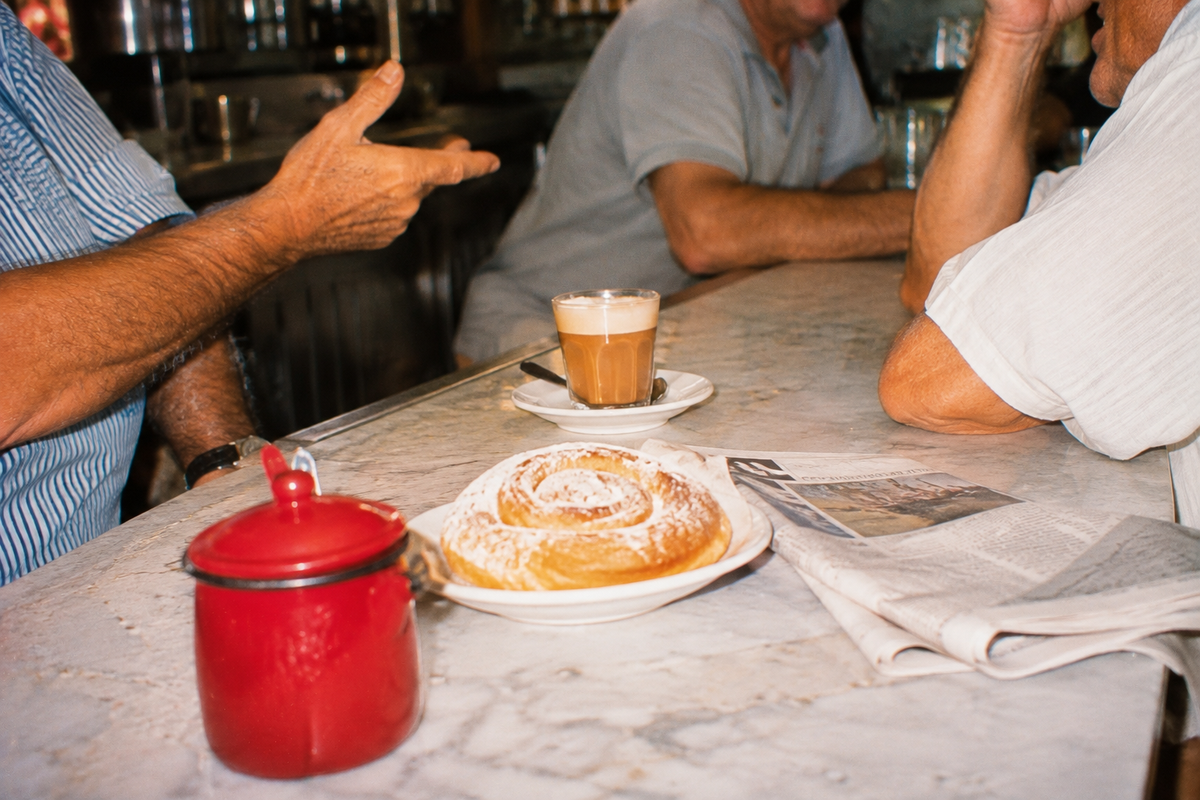
- Cafè amb llet – Coffee with milk
- Bon profit! – Enjoy your meal
- Salut! – Cheers
- Ca nostra – Our home, often used for a finca
- Al·lot / al·lota – Boy / girl
- Idò – So, then, the island’s favourite word
- Molt bé – Very good
- On és…? – Where is…?
- Obert / Tancat – Open / Closed
- Dilluns, dimarts, dimecres, dijous, divendres, dissabte, diumenge – Monday to Sunday, useful for market days
- Festa – Festival
- Mercat – Market
- Sa Roqueta – “The little rock,” a nickname Mallorquines use for their island
What to order at the bar, from a cortado to a carajillo, is explained in Ordering Like a Mallorquí. Dishes from A to Z: Mallorquí Dishes. Why the island is bilingual: Mallorca’s History.
Frequently Asked Questions
What language do people speak in Mallorca?
Spanish and Catalan are both official languages. The island’s Catalan is called Mallorquí.
Is Mallorquí a separate language?
No, it is a variant of Catalan with its own words and the articles es and sa.
Can you get by in Mallorca with German or English?
Usually, yes, in the holiday resorts. In the villages, Spanish and a few words of Mallorquí will help.
What does Son mean in place names?
Son refers to a country estate that once belonged to a family, such as Son Vida or Son Servera.