Algaida and Randa: sacred mountain, glassworks and the Cossiers
Algaida is a village that most people drive through on their way to Manacor. It is home to the island's sacred mountain, a glassworks older than the United States, and a dance that dates back to the Middle Ages.
Von Thorsten Kambach5 Min. Lesezeit
In diesem Beitrag 7 Abschnitte
The municipality of Algaida is located around 22 kilometres east of Palma on the Ma-15 and consists of three towns: Algaida itself, the small village of Pina in the north, and Randa at the foot of the mountain of the same name. More than 6,000 people live here. Plenty of agriculture, little tourism, short distances – the airport is about a 20-minute drive away.
What can you see in Algaida?
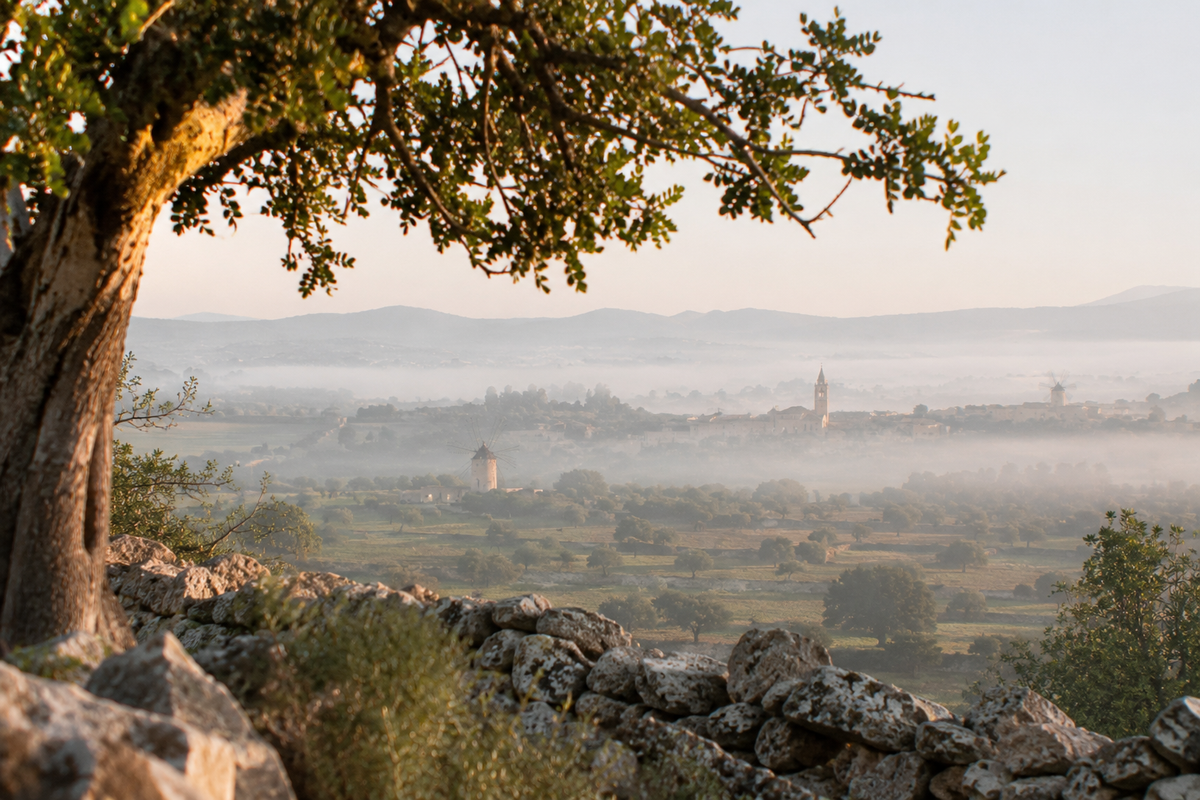
Algaida is above all an authentic village in the centre of the island: the Sant Pere i Sant Pau parish church with Gothic and Baroque sections, a main square, bars where you can order coffee with ensaimada in the morning, and windmills on the outskirts of the village. There is a weekly market on Friday mornings in Plaça Major (as of November 2026; please check locally). All the island's market days: Weekly markets in Mallorca.
If you are not coming to shop, but to see the sights, there are three good reasons to visit: Puig de Randa, the Gordiola glassworks, and – if the timing is right – the Cossiers.
What is Puig de Randa?
Puig de Randa is a 540-metre-high plateau in the middle of the plain and is considered Mallorca's sacred mountain because three monasteries stand on it. A winding road leads from the village of Randa to the summit and connects all three.
- Santuari de Gràcia: The lowest of the three, built in the 15th century and nestled under a rocky overhang on the sheer cliff. From the terrace, you can look out over the south of the island.
- Santuari de Sant Honorat: At mid-height, dating from the 14th century, and the quietest of the three.
- Santuari de Cura: At the very top. The scholar Ramon Llull, the island's most important thinker, retired here in the 13th century. A small museum tells the story of him and the monastery. There is also a restaurant and guest rooms at Cura.
The view is the real reward: According to the Balearic Government (CAIB), from the summit you can see the entire Serra de Tramuntana with Puig Major to the northwest, the Serres de Llevant to the east, and on clear days all the way across to the island of Cabrera. More about the area south of the mountain: Llucmajor and Puig de Randa.
Can you cycle to Puig de Randa on a road bike?
Yes, the climb to Cura is one of the most famous road cycling classics in the centre of the island: around five kilometres from the village of Randa to Cura, with a break and a view at the top. Especially in spring, Randa is a popular destination for cycling groups that do not always want to ride in the Tramuntana. Tours and season: Road cycling in Mallorca. If you are training for the big spring race: Mallorca 312 in April 2027.
What is the Gordiola glassworks?
Gordiola is Mallorca's oldest glassworks, founded in 1719 and still family-run today, now in its eleventh generation. The house on the Ma-15 between Palma and Algaida looks like a small castle. Inside, glass is still blown by hand, and since 1977, there has also been a glass museum featuring pieces from antiquity to the present day. The craftsmanship of hand-blown glass, of which Gordiola is part, was added to the UNESCO list of Intangible Cultural Heritage in December 2023.
For you, this means: an excursion that works even in the rain, fascinates children, and leaves you with a souvenir that really comes from here. Please check the opening times and admission before visiting.
Who are the Cossiers of Algaida?
The Cossiers are a dance considered Mallorca's oldest folk dance, with evidence dating back to the 14th century. Six dancers in white with colourful skirts and sashes dance together with a Dama, who embodies goodness, and a Dimoni, a devil who tries to disrupt everything and provides plenty of laughs. This is how the Balearic Islands Tourism Board describes it.
They can be seen twice a year:
- 16 January: for the Sant Honorat festival, in winter, with bonfires and a village atmosphere.
- 24 and 25 July: for the Sant Jaume festival, in honour of the town's patron saint. 25 July is the main day.
If you are in Mallorca in July, you should mark the date in your calendar. The exact times are published every year in the municipality's festival programme. Other festivals on the island: Public holidays and festivals 2027.
Where is the best place to stay near Algaida?
If you want to experience Algaida and Randa, the best place to stay is in the centre of the island or in the south. From there, the mountain, the glassworks, and the markets in neighbouring villages are all quickly accessible, as are Palma and the airport. You can find our houses in the plain under Finca in the centre of the island, and the houses towards the south coast under Finca in southern Mallorca.
Why it remains quiet here even in August is explained in Overtourism in Mallorca: where the island is still quiet. And how far you have to drive from the centre of the island to the nearest beach is shown in our analysis How far are fincas from the beach?
We deliberately do not list any restaurants here – the menus in the villages change faster than a magazine article can be published. Ask the WOW CONCIERGE where to eat well in the area at the moment. We will make a reservation for you too.
Frequently Asked Questions
How high is Puig de Randa?
Puig de Randa is 540 metres high. A road leads from the village of Randa to the monastery of Cura on the summit.
Which three monasteries stand on Puig de Randa?
From the bottom up: Santuari de Gràcia, Santuari de Sant Honorat, and Santuari de Cura, where Ramon Llull is said to have lived.
When do the Cossiers dance in Algaida?
On 16 January for the Sant Honorat festival and on 24 and 25 July for the Sant Jaume festival.
How far is Algaida from Palma?
Around 22 kilometres along the Ma-15. By car, you will be in Palma or at the airport in about 20 minutes.